 is here! Shop now, pay later in 4 easy installments


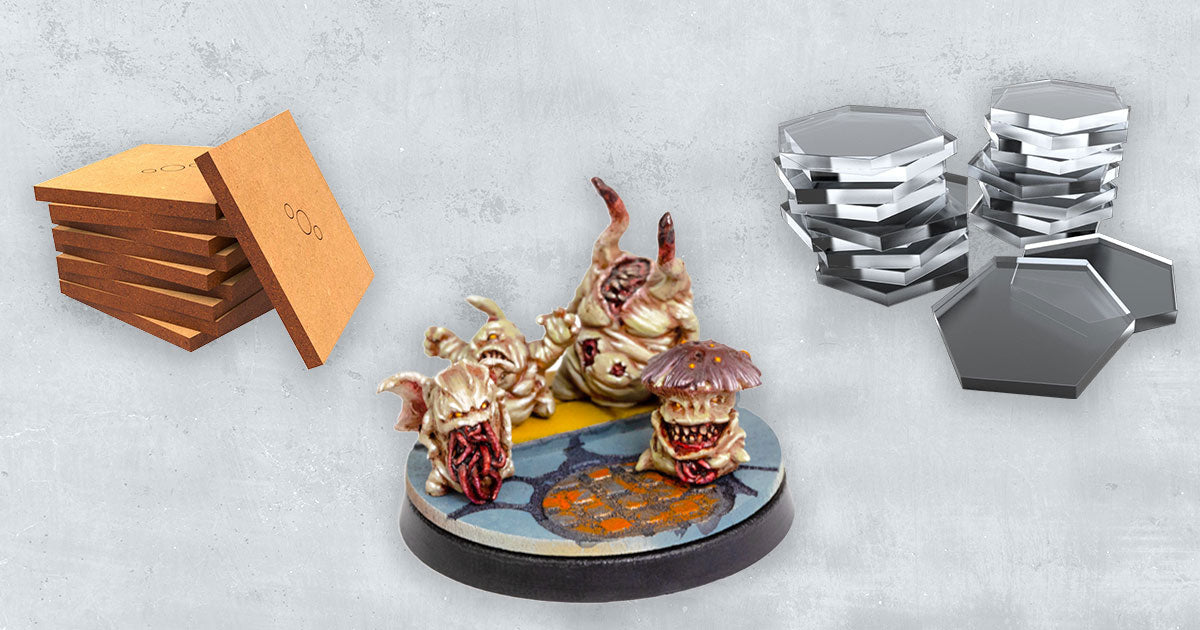
Why Base Size Matters More Than Your Army List
We've all been there. You rock up to game night with your perfectly painted army, only to have someone point out that half your units are on the wrong base sizes. Suddenly, what seemed like a minor detail becomes a major headache. At Hearns Hobbies, we see this scenario play out regularly, and honestly? Base sizes matter way more than most players realise.
The thing is, miniature bases aren't just plastic discs that keep your models upright. They're fundamental game pieces that affect movement, combat ranges, board control, and even tournament legality. That 5mm difference between a 25mm and 30mm base might seem trivial, but it can completely change how a unit performs on the tabletop.
Here's what really gets players: base sizes have evolved dramatically over the years, and different game systems handle this evolution in wildly different ways. Some companies update their base requirements with each new edition, leaving players scrambling to rebase entire armies. Others maintain legacy support, creating a confusing mix of old and new standards. And don't even get me started on the chaos when different regions adopt different standards...
This guide cuts through the confusion to explain why base sizes have such a massive impact on competitive play. We'll explore the hidden mechanics that make a 32mm base fundamentally different from a 25mm one in actual gameplay. More importantly, we'll show you how to navigate base size requirements without going mad or breaking the bank on rebasing supplies.
Table of Contents
The Hidden Gameplay Mechanics of Base Sizes
Let's start with the basics that aren't so basic. Every millimetre of base diameter translates directly into board control. A unit of ten models on 32mm bases covers roughly 80% more area than the same unit on 25mm bases. That's not a typo - we're talking about nearly double the footprint for what appears to be a minor size increase.
Movement becomes the first casualty of base size confusion. Larger bases mean models can't squeeze through the same gaps, can't pack as tightly in deployment zones, and can't achieve the same model density in combat. I've watched tournament games decided because someone couldn't fit their unit through a 3-inch gap that would've been simple with smaller bases. These round bases create invisible walls that completely reshape battlefield navigation.
Combat engagement ranges tell an even more dramatic story. In most game systems, you measure from base edge to base edge for melee combat. A model on a 40mm base fighting another on a 40mm base starts with 80mm of "free" engagement range compared to 25mm based models. This affects pile-in moves, consolidation distances, and the number of models that can actually swing in combat. Suddenly, that elite unit with massive bases can't bring its full offensive power to bear because geometry literally prevents it.
But here's where it gets really interesting: aura abilities and buff ranges. Most games measure these effects from the model (usually meaning the base edge), not from a central point. A character on a 60mm base projecting a 6-inch aura actually covers significantly more area than the same character on a 40mm base. We're talking about hundreds of extra square inches of coverage - enough to catch additional units that would otherwise miss out on crucial buffs.
![[SUGGESTED IMAGE: Visual comparison showing different base sizes (25mm, 32mm, 40mm, 60mm) with overlay circles demonstrating aura coverage differences]](https://www.hearnshobbies.com/cdn/shop/files/mdf-bases-square-25-mm_174d99ee-875e-49ee-bfd4-a4eed49b5298.jpg?v=1750217180&width=800)
Competitive Implications and Tournament Standards
Tournament play transforms base size from a minor detail into a major compliance issue. Every major competitive circuit maintains strict base size requirements, and showing up with non-compliant bases can result in anything from warnings to disqualification. But here's the kicker - these standards aren't always consistent between different tournaments or even different regions running the same game system.
The modelling for advantage debate rages particularly hot around base sizes. Using smaller bases to fit more models into combat or larger bases to claim more board space both constitute unfair advantages in competitive play. Tournament organisers have become increasingly vigilant about base compliance, with some events requiring base size verification during list submission. I've seen players forced to borrow models or sit out events because their lovingly painted army was on bases from two editions ago.
Legacy model support creates its own special category of headaches. When game companies update base sizes, they rarely mandate immediate conversion of existing models. This creates a two-tier system where identical units might legally field different base sizes depending on when they were purchased. Smart players exploit this by choosing whichever option provides tactical advantage - perfectly legal but ethically questionable. Some tournaments now specify "current production standard" to close this loophole.
The financial impact hits competitive players particularly hard. Rebasing an entire army isn't just about buying new bases - it's hours of work carefully removing models, cleaning off old basing materials, and starting fresh. For players with multiple armies, we're talking hundreds of dollars and dozens of hours. No wonder base size changes generate such passionate responses from the community.
Tournament Preparation Tip
Always check base size requirements when registering for events. Many tournaments publish specific base size charts months in advance. Screenshot or save these requirements - tournament organisers won't accept "but the website said" arguments on game day. When in doubt, contact the TO directly for clarification.
How Different Game Systems Handle Base Sizes
Each major game system approaches base sizes with its own philosophy, creating a complex landscape for players who enjoy multiple games. Some systems treat bases as purely functional, while others integrate them deeply into core mechanics. Understanding these differences helps explain why that perfectly based army for one game might be completely wrong for another.
Age of Sigmar probably handles base transitions most generously. Games Workshop explicitly states that models can use whatever bases they were supplied with, creating a situation where the same unit might field multiple base sizes legally. However, matched play events increasingly standardise on current production bases. The community has largely self-regulated toward consistency, but you'll still encounter mixed-base units at casual tables. This flexibility sounds great until you realise it creates genuine balance issues - those old 25mm bases pack way more models into combat than modern 32mm ones.
Warhammer 40,000 takes a stricter approach, with base sizes considered part of a model's rules profile. The game explicitly measures from base edges for everything from movement to weapon ranges, making base size a fundamental balance factor. Yet even here, legacy support creates oddities. Space Marines alone have transitioned through three different base sizes over the years, and all remain technically legal. Competitive events typically mandate current standards, but casual play remains a wild west of base sizes.
Historical games add another layer of complexity by often specifying base sizes as part of unit formation rules. Here, bases aren't just individual model platforms but components of larger movement trays and formations. Changing base sizes can literally break the game's formation mechanics. Many historical systems solve this by standardising on specific base dimensions that haven't changed in decades, but this creates its own problems when manufacturers update their miniature scales.
Skirmish games like Infinity or Marvel Crisis Protocol integrate base size directly into model profiles and special rules. A model's base size might determine its silhouette for line-of-sight purposes or affect its ability to claim objectives. These games typically have zero tolerance for base size variation because changing bases fundamentally alters a model's capabilities. The upside? No legacy confusion. The downside? No flexibility whatsoever.
Common Base Size Standards by System
| Game System | Infantry Standard | Update Frequency |
|---|---|---|
| Warhammer 40K | 32mm (was 25mm) | Every 2-3 editions |
| Age of Sigmar | 25mm-32mm varies | With new releases |
| Warmachine | 30mm standard | Rarely |
| Infinity | 25mm standard | Never |
Smart Conversion and Adaptation Strategies
Alright, so you've discovered your army's on the wrong bases. Before you rage-quit the hobby, let's talk practical solutions. The good news is that rebasing doesn't have to mean starting from scratch, and there are clever ways to maintain compatibility across multiple systems or editions.
Base adapters have become the unsung heroes of the modern wargaming scene. These simple plastic rings let you temporarily upsize bases without permanent changes. Pop your 25mm based model into a 32mm adapter ring, and you're tournament legal in seconds. The best part? You can remove them just as easily for games that require original bases. Companies now make adapter rings for virtually every common base size transition.
For permanent conversions, the key is preserving your existing base work. Rather than ripping models off and starting fresh, many players now use a technique called base-stacking. Carefully cut the sides off your old base, leaving just the top surface with your model attached. Glue this onto a new, larger base and blend the edges with texture paste or putty. You keep all your original basing work while meeting new size requirements. Genius, right?
Magnetisation offers the ultimate flexibility for multi-system players. By magnetising your models at the ankles or waist (depending on the miniature), you can swap between different pre-made bases as needed. This works particularly well for character models that might need different bases for different game systems. Yes, it's more initial work, but teh freedom to switch systems without rebasing is worth it for players who bounce between games.
The budget-conscious approach involves selective rebasing. Not every model in your army needs immediate attention - prioritise units that gain the most from proper base sizes. Characters with aura abilities? Definitely rebase those. That unit of 30 infantry that mostly sits on objectives? They can wait. By focusing on high-impact rebasing, you can achieve tournament compliance without breaking the bank on new bases.
![[SUGGESTED IMAGE: Step-by-step visual guide showing base adapter installation, base-stacking technique, and magnetization process]](https://www.hearnshobbies.com/cdn/shop/products/town-streets-100mm-round-base-topper_4a86988f-22a8-4c94-ba0a-65bfd88c44da.jpg?v=1739872098&width=600)
The Mathematics Behind Base Size Balance
Now for the number crunching that makes tournament players sweat. The mathematical implications of base sizes extend far beyond simple area calculations. When game designers balance units, they factor in base sizes as a fundamental constraint on model performance. Change that constraint, and the whole equation shifts.
Let's talk coherency first. Most games require models in a unit to maintain coherency - typically 1-2 inches between models. With 25mm bases, a unit of 10 models can stretch into a rough line about 15 inches long while maintaining coherency. The same unit on 32mm bases? You're looking at nearly 20 inches. That's 33% more board coverage from a simple base change. In objective-based games, this difference between controlling one objective or stretching to claim two.
Combat mathematics get even wilder. Consider a standard combat where models within 1 inch of enemies can fight. With 25mm bases (roughly 1 inch diameter), models in base contact are already at maximum range. But 40mm bases (1.5 inch diameter) create a situation where models can be "in combat" while maintaining a gap between bases. This affects everything from pile-in movements to the number of attacks that can target specific models.
The volume problem compounds these issues. A unit's footprint isn't just about flat area - it's about the three-dimensional space it occupies on terrain-heavy boards. Larger bases mean fewer models can fit on building floors, behind cover walls, or inside transports. I've seen games where a crucial unit couldn't claim an objective because their bases literally wouldn't fit in the ruins. No amount of tactical genius overcomes basic geometry.
Here's the really mind-bending part: probability curves shift with base sizes. Blast weapons that hit "D6 models" perform differently against units with varying base sizes. Template weapons balanced for 25mm bases become either overpowered or useless when base sizes change. Some game systems have literally rewritten entire weapon categories because base size changes broke the original mathematical balance.
Quick Math Reference
Area increase from common base transitions: 25mm to 32mm = 64% more area | 32mm to 40mm = 56% more area | 25mm to 40mm = 156% more area. These aren't minor differences - they're game-changing multipliers that affect every aspect of play.
Future-Proofing Your Collection
After watching base sizes evolve across multiple game editions, smart hobbyists have learned to plan ahead. Future-proofing your collection isn't about predicting exactly what changes will come - it's about building flexibility into your armies from the start. The strategies that work best combine practical solutions with an understanding of where the industry's heading.
The trend toward larger bases seems irreversible. As miniatures become more detailed and dynamic, they need more stable platforms. That cool dynamic pose with the model leaping off a rock? It needs a bigger base for balance. Those flowing capes and extended weapons? Same story. When building new armies, err on the side of current production standards rather than trying to squeeze by with minimum base sizes. Your future self will thank you.
Documentation has become crucial for serious collectors. Keep records of when you purchased models and what bases they came with. Photograph your armies with clear shots of base sizes. Some players even keep the original packaging or instruction sheets as proof of legitimate base sizes. This might seem excessive, but when tournament organisers question your base choices, documentation beats arguments every time.
Building with modularity in mind changes everything. Instead of super-gluing models directly to bases, consider pinning them. Use clear acrylic bases for display models that can be swapped onto game-legal bases when needed. Design your base decoration schemes to work across multiple base sizes - a rim of static grass looks good whether the base is 25mm or 40mm.
Community standards often preview official changes. Pay attention to what top players and content creators use for their armies. When influential community members start standardising on certain base sizes, official updates often follow within a year or two. Being ahead of the curve means avoiding the mad scramble when changes become mandatory.
New Army Checklist
- • Check current tournament standards
- • Buy bases in bulk for consistency
- • Consider magnetisation for characters
- • Document purchase dates
- • Plan for future changes
Collection Maintenance
- • Annual base size audit
- • Track rule updates
- • Maintain adapter inventory
- • Update documentation
- • Budget for transitions
Common Base Size Controversies
The base size debate has spawned some legendary controversies in the tabletop community. Understanding these flashpoints helps navigate the social aspects of base compliance and avoid accidentally stepping into heated arguments at your local game store.
The "historical accuracy" argument rages particularly fierce in certain circles. Some players insist that changing base sizes retroactively invalidates years of collecting and ruins the aesthetic coherence of older armies. They've got a point - seeing identically equipped units on different base sizes looks weird and breaks immersion. Others argue that game balance trumps nostalgia. Both sides get pretty passionate, and there's no universal right answer.
Proxy basing during transitions creates its own drama. When new base sizes are announced but not yet widely available, players cobble together temporary solutions. I've seen everything from cardboard cutouts to stacked coins used as "temporary" bases. Some groups embrace this creativity, while others see it as gaining unfair advantage during the confusion of transitions. The resulting arguments can split gaming groups.
Third-party bases add another layer of complexity. Not all bases are created equal - some manufacturers make bases slightly larger or smaller than official standards. A "32mm" base from one company might be 31mm or 33mm from another. These minor variations seem trivial until someone breaks out the calipers at a tournament. Always verify third-party bases match official specifications before buying in bulk.
The most heated debates emerge around "optimal" base sizes for competitive advantage. When players have legitimate choices between base sizes, min-maxers calculate exact advantages for each option. Should your character take the smaller base for easier movement or the larger base for better aura coverage? These discussions can devolve into spreadsheet warfare that makes normal people's eyes glaze over. Yet understanding these optimisation debates helps you make informed choices for your own armies.
![[SUGGESTED IMAGE: Forum screenshot or illustration showing heated base size debate, or comparison photo of same unit on different era bases]](https://www.hearnshobbies.com/cdn/shop/files/acrylic-bases-hexagonal-30-mm-clear.jpg?v=1743031236&width=800)
Practical Solutions for Multi-System Players
For those of us who can't stick to just one game system (and honestly, who can?), base sizes become an even bigger puzzle. Each game wants different things, and maintaining separate armies for each system isn't financially realistic. So let's talk about practical solutions that actually work in the real world.
The universal base system has gained traction among serious multi-system players. Pick one base size that works adequately across all your games - usually the largest size any system requires. Yes, your models might be slightly suboptimal in some games, but they're legal everywhere. For infantry, 32mm bases work across most modern systems. It's not perfect, but it beats rebasing armies every time you switch games.
Clear acrylic adapters revolutionise multi-system play. These transparent rings let you change effective base sizes without hiding your original base work. Unlike opaque adapters, clear ones maintain the visual coherence of your army. Some players have built entire adapter systems with color-coded rings for different games. Tuesday night's 40K game? Pop on the red rings. Thursday's Age of Sigmar? Switch to blue. Simple and effective.
Movement tray solutions work brilliantly for rank-and-file games. Build your models on individual bases sized for skirmish games, then use movement trays to form them into units for mass battle systems. This approach lets the same models pull double duty across vastly different game types. The key is designing trays that accommodate your chosen base sizes while meeting formation requirements.
Digital documentation streamlines multi-system compliance. Create a simple spreadsheet listing each unit's base requirements across different systems. Laminate it and keep it with your army case. When setting up for a game, you can quickly verify you're using the right bases or adapters. Some players even use phone apps to track base requirements and alert them to recent changes. Yeah, it's nerdy, but it prevents game-day disasters.
Storage Solution
Invest in modular storage that accommodates different base sizes. Adjustable foam trays beat pre-cut options for multi-system armies. Label compartments by base size, not unit type. This organisation method makes switching between systems smoother and prevents that panicked searching for the right adapters ten minutes before game time.
Frequently Asked Questions
Can I use different base sizes in the same unit for visual variety?
Generally, no. Most game systems require uniform base sizes within a unit for balance reasons. Mixed bases create measurement inconsistencies and can be seen as modelling for advantage. However, some narrative or casual formats allow it for aesthetic purposes - always check with your opponent or event organiser. If you want visual variety, focus on dynamic posing and creative basing materials instead of different base sizes.
What's the most future-proof base size for new armies?
For infantry models, 32mm has become the sweet spot across most modern games. It's large enough to accommodate dynamic poses while small enough to maintain reasonable unit footprints. Characters and elite units increasingly use 40mm bases. When in doubt, check what the latest releases in your chosen faction are using - companies typically standardise new releases on their intended future base sizes. Building to current production standards usually gives you at least 3-5 years before any changes.
How do I remove models from bases without damaging them?
The freezer method works brilliantly for plastic models with super glue. Pop the model in the freezer for 2-3 hours - the glue becomes brittle and often pops right off with gentle pressure. For plastic glue or stubborn bonds, use a hobby saw to carefully cut through the base from underneath. Never use force or you'll snap ankles. Metal models respond well to gentle heating - a hair dryer softens most glues. Always work slowly and have spare glue ready for repairs.
Are base size requirements different for casual versus competitive play?
Absolutely. Casual games typically allow much more flexibility with base sizes, especially for older models. Many groups use "rule of cool" - if it looks good and isn't obviously exploitative, it's fine. Competitive play enforces strict standards that vary by event. Some tournaments require current production bases, others allow any officially supplied base size. Always check specific event packets for base requirements. When building an army, decide whether you're prioritising casual flexibility or competitive compliance - they often require different approaches.
Final Thoughts
Base sizes might seem like the most mundane aspect of tabletop gaming, but we've seen how they fundamentally shape everything from basic movement to competitive meta. That innocent-looking disc of plastic under your models carries more game impact than most special rules or wargear options. Understanding and respecting base sizes isn't just about following rules - it's about grasping a core element of game design.
The journey from 25mm to 32mm bases mirrors the evolution of our hobby itself. Models got more detailed, games got more sophisticated, and yes, bases got bigger to accommodate both. Fighting against these changes wastes energy better spent enjoying our games. Smart hobbyists adapt, finding creative solutions that preserve their investments while staying current with evolving standards.
Whether you're a competitive tournament grinder or a casual narrative player, base sizes affect your tabletop experience. The good news? Once you understand the principles we've covered, navigating base requirements becomes just another part of the hobby. With the right tools from our extensive base collection, you can build armies that look great and play by the rules - whatever those rules might be.