 is here! Shop now, pay later in 4 easy installments


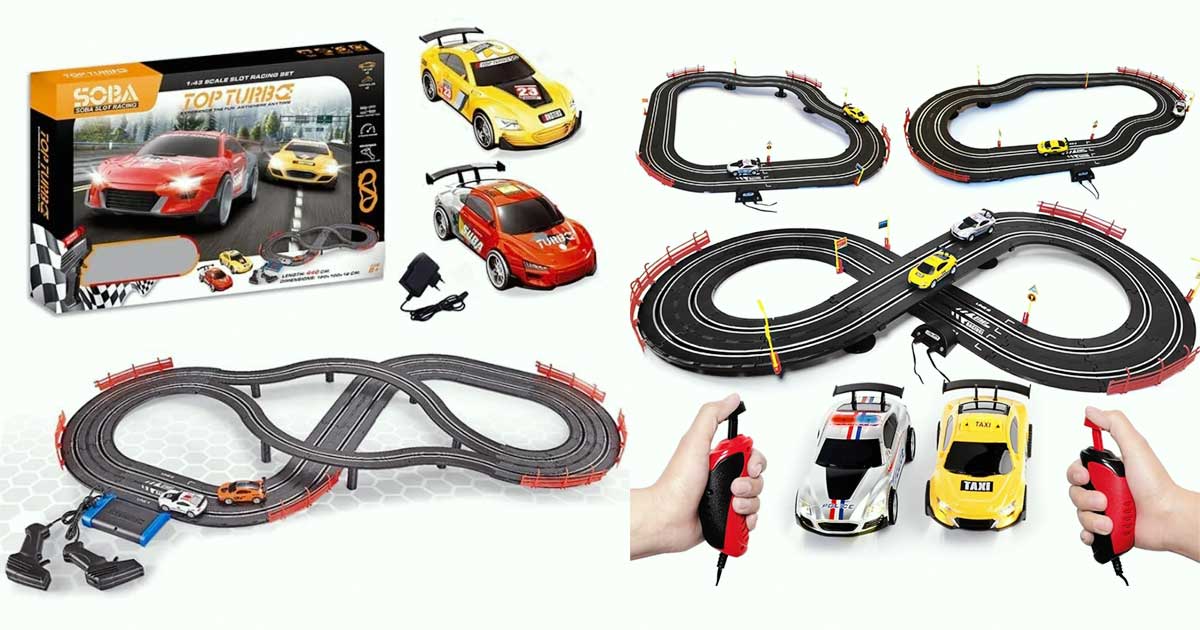
The Slot Car Track That Ate Your Spare Room
It started innocently enough. Just a simple Scalextric starter set for Christmas, maybe 2x3 metres of track on the dining table. "We'll pack it away after each session," you promised. Six months later, you're googling "structural engineers who understand slot car banking requirements" while your partner stands in what used to be the guest bedroom, now completely consumed by a multi-level racing empire. Sound familiar?
Welcome to the club of slot car enthusiasts whose tracks have achieved sentience and are slowly annexing every available square metre of living space. We've seen it happen countless times at Hearns Hobbies - customers who pop in for a few extra track pieces and leave discussing knocking through walls for their Monaco Grand Prix replica. The struggle between maintaining a functional home and building the ultimate racing layout is real, and honestly, the track usually wins.
The thing about slot car tracks is they're like that mate who crashes on your couch for "just a few days" and somehow never leaves. Before you know it, they've got their own Netflix profile and you're buying them groceries. Your track starts as a temporary visitor but gradually becomes a permanent resident with squatter's rights. And the worst part? You're completely fine with it because lap times have dropped by three-tenths.
We're here to explore this phenomenon - the creeping expansion of slot car layouts from humble beginnings to room-dominating monsters. Whether you're currently defending your territory against track encroachment or have already surrendered and are considering building an extension, this guide's for you. We'll look at why tracks grow, how to manage the expansion, and when to accept that resistance is futile.
Table of Contents
The Innocent Beginnings
Every slot car empire starts with a box. Usually it's a basic set - two cars, couple of controllers, enough track for a figure-eight or simple oval. "Perfect for rainy afternoons," you think, imagining wholesome family fun around the coffee table. The box promises everything fits neatly back inside after use. This is the biggest lie in all of hobby marketing, right up there with "assembly time: 20 minutes" on model kit instructions.
The first warning sign appears within days. That simple oval? Bit boring after the fifteenth race, innit? You discover extension packs exist. "Just a few curves to make it interesting," you rationalize, completely ignoring that your dining table is now permanently occupied and family dinners have moved to the kitchen counter. The track pieces multiply like rabbits - curves lead to straights, straights demand more curves, and suddenly you're eyeing that chicane section that would fit perfectly if you just moved the sofa a bit.
Then comes the accessories phase. Lap counters, because arguing about who's winning gets old. Borders and barriers because cars keep flying off at turn three. Maybe some grandstands for atmosphere. Before long, you've got more infrastructure than the Melbourne Grand Prix, and packing it away after each session takes longer than the actual racing. So you leave it set up "just for the weekend." That weekend was six months ago.
The transformation from casual racer to layout obsessive happens gradually. You start noticing dead space in your home differently. That corner behind the door? Perfect for a hairpin. The hallway? Ideal for a long straight with proper run-up to the living room chicane. You catch yourself measuring rooms not in metres but in track sections. Normal people see a spare bedroom; you see potential elevation changes and banking opportunities.
![[SUGGESTED IMAGE: A modest slot car starter set on a dining table, showing the innocent beginning stage with basic track layout]](https://www.hearnshobbies.com/cdn/shop/files/ea06bdd555.jpg.500x500.jpg?v=1734917902&width=500)
Early Warning Signs Your Track Will Take Over
• You know track piece part numbers by heart
• "Just one more section" becomes your catchphrase
• You've mentally redesigned your home's floorplan for better racing lines
• Family photos have been moved to accommodate pit lane scenery
• You refer to rooms by track sections ("dinner's ready in the Dunlop Chicane!")
The Expansion Creep Phenomenon
Track expansion follows predictable patterns, like a virus spreading through your floorplan. First, you justify keeping it assembled because "setup takes ages." Then you realise that permanent setup means you can add complexity without worrying about rebuild time. This is where things get dangerous. Suddenly, every Scalextric or Carrera catalogue becomes house renovation inspiration.
The mathematics of slot car expansion are terrifying. A basic oval might be 2x1 metres. Add some interest with curves and straights, you're at 3x2. Throw in that crossover section you've been eyeing, now we're talking 4x3. But tracks aren't rectangular - they sprout extensions like tentacles. That overtaking straight needs run-off area. The banked corner requires support structure. Before you know it, your "compact" layout has a larger footprint than your actual car.
What really accelerates expansion is discovering different track systems can be combined. You started with Scalextric Sport, but then you learn about digital systems. Now you need converters, additional power supplies, and somehow you're rewiring your spare room with more electrical work than a small recording studio. Each upgrade demands more space, and space, like nature, abhors a vacuum - empty floor quickly fills with track.
The social aspect feeds the growth too. Mate comes over, suggests a longer straight for proper drag racing. Another friend mentions elevation changes add excitement. Someone gifts you track pieces for your birthday (enablers, the lot of them). Your layout grows not through deliberate planning but through accumulated suggestions, gifts, and "wouldn't it be cool if" moments that somehow manifest into reality.
The Expansion Timeline
| Stage | Space Required | Denial Level |
|---|---|---|
| Starter Set | 2x1 metres | "It packs away!" |
| First Extension | 3x2 metres | "Still manageable" |
| Getting Serious | 4x3 metres | "It's a hobby room now" |
| Full Room Takeover | Entire room | "We didn't need guests anyway" |
| Considering Walls | Multiple rooms | "Open plan is trendy" |
Evolution of a Spare Room
Let's trace the typical lifecycle of a spare room's transformation into a racing circuit. Month one: track lives in the cupboard, assembled on weekends. Month two: track stays up "because friends are coming over Saturday." Month three: computer desk pushed against wall to accommodate permanent chicane. Month six: bed removed because "no one uses it anyway" and you need space for the mountain section.
The furniture exodus happens in stages. First to go are the unnecessary items - that exercise bike no one used, boxes of stuff meant for sorting. Next, functional furniture gets reorganised around the track rather than vice versa. The desk becomes a control station. Bookshelves transform into grandstands. That wardrobe? Perfect backing for the banked corner. You're not removing furniture; you're "repurposing the space for optimal usage."
Wall decorations evolve too. Family photos get replaced with racing posters. That nice painting? Swapped for a track map showing ideal racing lines. You install shelves, but not for books - they're for spare cars, controllers, and that growing collection of track accessories. The room's entire aesthetic shifts from "welcoming guest space" to "Ferrari garage circa 1967."
The really committed (or completely lost, depending on perspective) start modifying the actual room structure. Ceiling hooks for suspended track sections. Wall-mounted brackets for elevation. Some absolute legends we know have cut holes between rooms for track continuation. "It's reversible," they claim, while standing in a room that looks like someone crossed a racetrack with an M.C. Escher drawing.
![[SUGGESTED IMAGE: A spare room completely transformed into an elaborate multi-level slot car track with racing memorabilia on walls]](https://www.hearnshobbies.com/cdn/shop/products/U10297X200-Pista-Recta-Standard-360-blister-1-1024x1024.jpg?v=1722266358&width=1000)
Negotiating With Non-Racing Household Members
Living with non-racers while your track expands requires diplomatic skills that'd make the UN jealous. The key is gradual normalisation. Don't announce "I'm taking over the spare room for racing." Instead, leave track up accidentally-on-purpose. Express surprise when they notice. "Oh, that? Just testing a new configuration. Say, while it's up, fancy a race?"
The bargaining phase is crucial. For every square metre of track expansion, offer something in return. "If I can extend into the hallway, I'll finally fix that squeaky door." "The dining room corner? Sure, but I'll cook dinner all next week." These negotiations never mention that fixing the door takes an hour while the track extension is permanent. Details, details.
Smart expandists involve family members in the process. Let partners choose car liveries. Have kids name track sections. Create "their" corner of the layout. Once they've got emotional investment, they're less likely to demand dismantling. It's psychological warfare disguised as family bonding. Plus, "but the kids love it" is a powerful argument when defending territory.
When resistance appears, deploy the hobby defense. It's cheaper than golf. Safer than motorcycles. More social than video games. At least you're home, not at the pub. You're teaching kids about physics and competition. These arguments work surprisingly well, especially when delivered while offering a cup of tea made with the kettle you've relocated to make room for the pit lane.
Negotiation Tactics That Work
- The slow creep method
- Strategic gift-giving
- Family race nights
- The "it's educational" angle
- Comparative hobby costs
Arguments to Avoid
- "It's my house too"
- "You never used that room"
- "Racing is life"
- "The track stays or I go"
- "Professional racers started like this"
Maximising Your Layout Space
Once you've accepted the track's permanence, it's time to optimise. Vertical space is your friend - elevated sections double your racing area without increasing floor footprint. Think of your room as a 3D puzzle where every cubic metre counts. Under-track storage for spare cars, over-track lighting rigs, wall-mounted tool stations - embrace the vertical realm.
Modular design lets you reconfigure without complete rebuilds. Create sections that connect via standard straights, allowing layout changes for variety. Monday's Monaco becomes Friday's Silverstone with strategic reconnection. This also provides the illusion of change, keeping partners happy that "at least it's not always the same track" whilst you secretly know it's actually getting bigger each reconfiguration.
Consider multipurpose furniture that serves both racing and living needs. Ottoman storage boxes along track edges provide seating and spare parts storage. A coffee table with removable top reveals a sunken track section. Bar stools work as race viewing positions and actual seating. You're not sacrificing living space; you're creating "dual-purpose recreational areas."
The ultimate space hack? Suspended ceiling tracks. Using strong fishing line or clear acrylic supports, tracks can run above head height around room perimeters. It's like having a second floor that only slot cars can access. Yes, it looks mental. Yes, visitors will question your sanity. But you've gained 30% more track without losing any floor space. That's just good mathematics.
Space-Saving Track Features
Folding Sections: Hinged areas that flip up against walls when "needed"
Under-Furniture Routes: Tracks running beneath sofas and beds
Retractable Straights: Sliding sections that extend for races, retract for "living"
Ceiling Mounting: The final frontier of track expansion
Garden Shed Annex: When indoor negotiations fail completely
When Temporary Becomes Permanent
There's a moment in every slot car enthusiast's journey when you stop pretending the track is temporary. Usually it coincides with drilling the first hole in a wall or buying furniture specifically to support track sections. This is the point of no return, the event horizon of the hobby black hole. Embrace it.
The transition manifests in small ways. You stop explaining the track to visitors - it's just part of the house now, like the kitchen or bathroom. "Mind the chicane" becomes as normal as "watch the step." You plan room redecoration around existing track layouts. Paint colours are chosen to complement racing liveries. You've crossed from "person with slot car track" to "person whose house has a slot car track."
Permanent installation opens new possibilities. Proper wiring hidden in conduits. Dedicated power supplies on separate circuits. Professional timing systems permanently mounted. LED strip lighting programmable for different race conditions. You're not just racing; you're creating an experience. The fact that this experience has consumed 40% of your living space is beside the point.
The real sign of permanence? When you factor the track into house valuations. Estate agents look confused when you list "professional-grade slot car facility" as a feature, but you know some buyer out there will pay premium for a pre-installed setup. Until then, you're adding value through "recreational infrastructure investment." Your partner might call it something else, but they gave up fighting it months ago.
![[SUGGESTED IMAGE: A permanently installed slot car track with professional mounting, proper wiring, and integrated room design]](https://www.hearnshobbies.com/cdn/shop/products/61ZHGauEAQL._AC_SL1199.jpg?v=1734699231&width=800)
Multi-Level Madness
Single-level tracks are for quitters. Real enthusiasts think in layers, like a expensive racing lasagne. Multi-level layouts don't just double your track length; they create dramatic elevation changes, thrilling overpasses, and the constant possibility of cars plummeting onto unsuspecting lower-level racers. It's brilliant and terrifying in equal measure.
Building upward starts innocently with a simple bridge section. But bridges need approach ramps, and ramps need supporting structures, and suddenly you're constructing the slot car equivalent of the Sydney Harbour Bridge in your spare room. Support pillars multiply like mushrooms after rain. Your floor looks like a forest of plastic columns, each one critical to preventing catastrophic track collapse.
The engineering challenges are real. Banking angles that work at ground level become death traps at elevation. Cars that handle flat chicanes perfectly launch themselves into orbit on elevated ones. You find yourself doing actual calculations about weight distribution, centre of gravity, and structural load-bearing capacity. Your Google search history includes "civil engineering for dummies" and "how much weight can MDF support per square metre."
But when it works - oh, when it works! Watching cars race on three different levels simultaneously, diving under bridges, climbing mountain passes, spiraling through elevation changes... it's poetry in motion. Sure, retrieving crashed cars requires a stepladder, and changing lanes on the upper deck needs NBA-player reach, but these are small prices for three-dimensional racing glory.
Multi-Level Build Considerations
| Level | Height from Ground | Access Difficulty | Crash Recovery Method |
|---|---|---|---|
| Ground | 0 cm | Easy | Bend and grab |
| First Elevation | 30-50 cm | Moderate | Reaching required |
| Second Tier | 80-100 cm | Challenging | Step stool necessary |
| Ceiling Level | 200+ cm | Extreme | Ladder and prayer |
The Acceptance Stage
Eventually, everyone in the household reaches acceptance. The track is no longer an intruder but part of the home's character, like that wonky kitchen drawer or the bathroom door that needs a special jiggle to lock. Visitors stop asking "what's all this then?" because word's gotten round - you're the ones with the track. It's become part of your identity.
Acceptance brings peace. No more justification needed. No more promises to pack it away "after the holidays." The spare room is dead; long live the race room. You stop feeling guilty about the space consumption because honestly, how often did guests really stay? Once a year? The track gets daily use. That's just sensible resource allocation.
Your family develops track-related traditions. Sunday morning races with coffee. Birthday parties in the race room. Holiday championships with trophies made from spare parts. The track hasn't just taken over physical space; it's woven into family life. Kids learn about fair play, competition, and why daddy shouts at inanimate plastic cars. These are important life lessons.
The final stage of acceptance is pride. You give tours to visitors. You share layout photos in online forums. You consider starting a YouTube channel documenting races. The room that was once a source of domestic tension is now a talking point, a unique feature, a conversation starter. "Want to see the track?" becomes your version of "want to see my etchings?" except more innocent and definitely more fun.
WARNING: Acceptance of one room often leads to expansion into others. The garage looks awfully empty. The attic has potential. That shed could work with some insulation. Acceptance is not an endpoint - it's permission for phase two.
Signs You've Reached Acceptance
- Track appears in holiday cards
- Furniture shopping considers track compatibility
- You've named individual track sections
- Racing determines dinner time
- Track maintenance is in the household calendar
Benefits of Acceptance
- No more setup/packdown time
- Continuous layout improvement
- Family bonding opportunities
- Unique home feature
- Conversation starter extraordinaire
Frequently Asked Questions
How do I convince my partner that a permanent slot car track adds value to our home?
Frame it as a unique architectural feature rather than a toy. Mention that proper slot car installations are conversation pieces that make your home memorable. Point out the engineering skills kids learn, the family bonding time it creates, and how it's actually cheaper than many other hobbies when you calculate cost-per-hour of entertainment. If all else fails, remind them that at least you're not collecting vintage motorcycles that need garage space, or taking up golf which involves leaving house for hours. The track keeps you home, engaged, and available for household duties between races.
What's the maximum percentage of living space a slot car track can occupy before it becomes problematic?
According to our completely unscientific research at Hearns Hobbies, the sweet spot is around 25-30% of total floor space. This allows for a substantial layout while maintaining domestic harmony. Once you exceed 40%, you're entering "lifestyle choice" territory where the house serves the track rather than vice versa. Beyond 50%, you're basically living in a race facility with bedroom attached. That said, we know blokes who've hit 60% and claim they've never been happier - though they do eat a lot of takeaway since the dining table became turn seven.
Should I go digital or stick with analogue for a large permanent layout?
For large permanent layouts, digital systems are game-changers. Lane changing, multiple cars per lane, realistic fuel and tyre management - digital adds layers of strategy impossible with analogue. Yes, it's more expensive initially and requires more complex wiring, but for permanent installations, the added gameplay options justify the investment. Plus, you can run six cars simultaneously on a two-lane track, which means more mates can race together. The only downside is troubleshooting becomes more complex, and you'll need an IT degree to understand some digital controller settings.
How do I stop my slot car track from taking over another room after it's already consumed one?
Honestly? You probably can't. Track expansion is like entropy - it naturally increases over time. Your best bet is designated boundaries, preferably physical ones. Door frames make good natural barriers, though we've seen determined builders run track through doorways using bridge sections. Maybe try getting into miniature painting or model trains as a distraction? Actually, scratch that - those hobbies also consume entire rooms. Perhaps just accept that you're destined to live in increasingly smaller spaces while your hobbies expand to fill available area. It's not a bug; it's a feature of the enthusiast lifestyle.
Final Thoughts
The spare room is gone. It's been consumed, digested, and transformed into something far more exciting than a place for guests to sleep. Your slot car track hasn't just taken over physical space - it's created a focal point for fun, competition, and probably a few domestic disagreements about whether the new banked section really needs to extend into the hallway.
But here's the thing - hobbies that inspire this level of commitment are rare and valuable. In a world of passive entertainment and screen-time, you've built something tangible, something that brings people together for actual, physical, competitive fun. Yeah, you can't use your dining table anymore, and yes, visitors have to navigate through chicanes to reach the bathroom, but you've created unique memories and experiences that wouldn't exist without that space-consuming track.
So embrace the takeover. Let the track grow. Build that second level. Install those LED racing lights. Convert the garage while you're at it. Life's too short for boring spare rooms anyway. At Hearns Hobbies, we'll keep enabling your expansion with more track pieces, faster cars, and definitely no judgment about how much space you're dedicating to the hobby. After all, someone needs to push the boundaries of domestic racing facilities, and it might as well be you!