 is here! Shop now, pay later in 4 easy installments


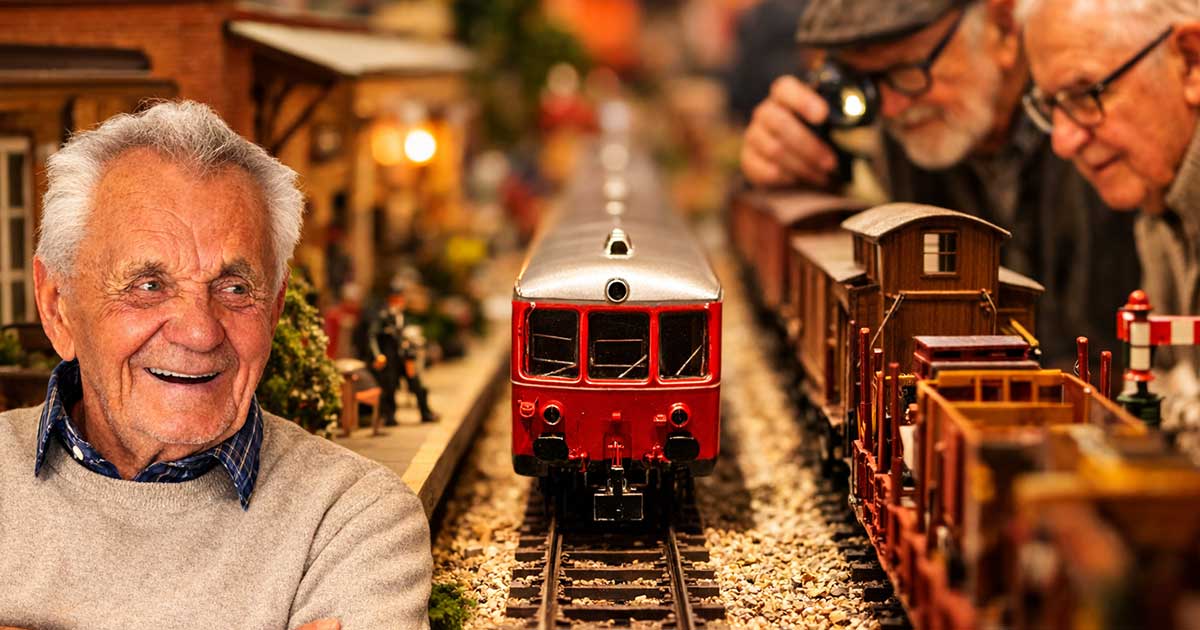
Why Old Blokes at Railway Exhibitions Know Everything
⚠️ Disclaimer: This article is a lighthearted, affectionate observation based on decades of exhibition attendance rather than rigorous scientific research. No actual studies were harmed (or conducted) in the making of this content. We love all exhibition-goers equally!
You've just walked into the model railway exhibition at your local hall, and within thirty seconds of admiring a beautifully detailed OO gauge layout, you hear it. That distinctive voice from behind you, probably wearing a polo shirt from a heritage railway, ready to explain in exquisite detail why that signal is positioned three inches too far from the platform for accurate 1957 Western Region practice.
The thing is, he's absolutely right. And he probably knows the exact date that signal box was decommissioned, who the stationmaster was in 1962, and whether the local goods yard handled fertiliser on Thursdays. After thirty-odd years running Hearns Hobbies, we've witnessed this phenomenon at every exhibition across Australia - these gentlemen (and they're mostly gentlemen, let's be honest) possess encyclopaedic knowledge that'd make a university professor weep with envy.
But why? What makes exhibition veterans such walking, talking railway databases? And more importantly, should we be grateful for their corrections or mildly terrified? Grab a cuppa and let's explore this endearing quirk of the Australian model railway scene, with all the affection these knowledge-keepers genuinely deserve.
Before you assume this is some dismissive piece taking the mickey out of dedicated hobbyists, let me be clear - these folks are the living memory of our railways, the guardians of obscure details that'd otherwise vanish forever. Yeah, they might correct your locomotive number with unsettling precision, but without them, half our railway heritage would be lost to time.
Table of Contents
They Actually Lived Through It
Here's the most obvious but frequently overlooked fact - many exhibition veterans didn't read about the steam era in books. They remember it. They stood on platforms as kids watching branch line trains roll through, smelled the coal smoke, heard the distinctive sounds of different locomotive classes, and memorised every detail because that's what railway-obsessed children did before smartphones existed.
When someone in their seventies corrects your scenery placement, they're not being pedantic - they're remembering actual geography from childhood trips. That seemingly random correction about goods shed doors? They probably helped their uncle load freight through that exact door in 1963. Their knowledge isn't theoretical; it's lived experience compressed into memory over decades.
This gives them an almost unfair advantage over younger modellers. You can study photographs until your eyes bleed, but it'll never match someone who watched these trains operate daily, who knew the rhythms of timetables, who remembers which platforms handled parcels and which handled passengers. They absorbed details unconsciously that we now struggle to research deliberately.
And here's what's brilliant - many of them recognise how precious this knowledge is. They know they're among the last generation to remember these things firsthand. That's partly why they're so eager (perhaps overly eager!) to share corrections. It's not arrogance; it's urgency. They're trying to pass along memories before those memories disappear forever.
![[SUGGESTED IMAGE: Elderly gentleman in a heritage railway volunteer vest examining a detailed model railway layout at an exhibition]](https://plus.unsplash.com/premium_photo-1663076415108-ca4facbcbff3?ixlib=rb-4.1.0&ixid=M3wxMjA3fDB8MHxwaG90by1wYWdlfHx8fGVufDB8fHx8fA%3D%3D&auto=format&fit=crop&q=80&w=1170)
The Pre-Internet Learning Advantage
Right, this might sound counterintuitive, but growing up without Google actually made these folks better learners in some ways. When you couldn't just search "Victorian Railways goods wagon specifications," you had to observe meticulously, ask questions relentlessly, and remember everything because you might never get another chance to learn it. Pre-internet learning required different cognitive skills - ones that prioritised retention over rapid access.
They built personal libraries of railway books that they actually read cover to cover, multiple times. No skimming Wikipedia articles or watching five-minute YouTube videos. They studied railway manuals, track diagrams, and historical records with the intensity of PhD students, because that was the only way to learn. This deep, focused study created knowledge structures in their minds that casual modern research simply can't replicate.
Plus, they learned to network for information long before social media existed. Want to know about a specific diesel locomotive? You wrote letters to enthusiasts, attended club meetings, visited railway offices, and built genuine relationships with people who knew things. This social knowledge-gathering created communities where information was shared generously because everyone understood its value.
The downside? Sometimes their knowledge has gaps where modern research could easily fill them. But the upside is incredible depth in their areas of focus. A younger modeller might know a little about everything (thanks to internet browsing). An exhibition veteran knows absolutely everything about three specific things, and those three things probably connect to dozens of other railway details in ways that'd take you years to discover.
The Knowledge Retention Difference
Studies on memory formation suggest that information acquired through effort and multiple exposures (like reading physical books repeatedly) creates stronger neural pathways than information quickly Googled and forgotten. Exhibition veterans essentially have decades-old knowledge that's been reinforced countless times through discussion, modelling practice, and teaching others. No wonder they remember wagon numbers from 1968!
Decades of Single-Minded Focus
Here's something we've noticed at Hearns - whilst younger customers often hop between hobbies (fair enough, there's lots to try!), the older generation tends to stick with model railways for, well, their entire adult lives. Fifty years of focused interest accumulates knowledge in ways that scattered enthusiasm simply can't match. They've been studying the same subject since before you were born.
Think about it mathematically. If someone's been actively modelling and researching for forty years, spending even just five hours weekly on the hobby, that's over ten thousand hours of railway-focused activity. Malcolm Gladwell reckoned you need ten thousand hours to master anything - these blokes have done that twice over whilst most of us are still figuring out how to properly install point motors.
But it's not just time; it's consistency of focus. Younger modellers (myself included, back in the day) get distracted by new scales, different eras, or entirely different hobbies. Exhibition veterans often modelled one specific railway, one specific era, for decades. That narrow focus means they know their chosen subject inside out, backwards, and probably in their sleep. Ask them about 1950s Southern Region operations and prepare for a three-hour lecture.
The funny thing? They often underestimate how much they know because to them, it's just "common sense" accumulated over decades. They'll casually mention some obscure operational detail as if everyone obviously knows it, not realising they're one of maybe twelve people in Australia who remember that specific practice. That's expertise so ingrained it's become invisible to the expert.
![[SUGGESTED IMAGE: Collection of vintage railway books, magazines, and reference materials on a desk with model railway tools]](https://images.unsplash.com/photo-1453053507108-9f5456eb481f?ixlib=rb-4.1.0&ixid=M3wxMjA3fDB8MHxwaG90by1wYWdlfHx8fGVufDB8fHx8fA%3D%3D&auto=format&fit=crop&q=80&w=1170)
The Community Knowledge Network
Exhibition veterans don't just possess individual knowledge - they're nodes in a decades-old knowledge network. Visit any model railway club and you'll see them sharing information, debating details, and collectively reconstructing railway history through conversation. This social knowledge-building creates a living database that no website can replicate.
We've watched this network operate for three decades. Someone mentions an obscure diesel railcar, and suddenly three different veterans chime in with complementary details - one remembers its operational history, another knows its technical specifications, a third has photographs from his uncle who drove it. Together, they reconstruct complete, verified histories that'd take months to research independently.
This network extends beyond local clubs. These folks attend exhibitions regularly, correspond with interstate enthusiasts, and maintain relationships built over decades of shared interest. When you ask an exhibition veteran a question, you're not just accessing his knowledge - you're accessing his entire network's collective wisdom. He might not know the answer, but he definitely knows someone who does.
What's particularly valuable is the quality control this network provides. Railway enthusiasts are famously particular about accuracy (some might say obsessive), so incorrect information gets challenged and corrected quickly. This peer review means the knowledge these veterans share has usually been verified multiple times through friendly arguments, cross-referencing, and collaborative research. They've essentially fact-checked each other for forty years.
Knowledge Network Benefits
- Collective memory spans decades
- Multiple verification sources
- Access to rare photographs and documents
- Connections to railway workers
- Cross-generational information sharing
How the Network Operates
- Regular club meetings for discussion
- Exhibition networking and conversation
- Correspondence and phone calls
- Shared archives and reference materials
- Mentorship of younger modellers
Many Worked on Real Railways
Here's something worth remembering - a surprising number of exhibition veterans didn't just observe railways; they worked on them. They're retired signalmen, former locomotive cleaners, ex-stationmasters, and workshop engineers. Their knowledge isn't theoretical hobby knowledge; it's professional expertise from actual railway careers. When they correct your signal placement, it's because they spent thirty years operating those actual signals.
This insider knowledge is gold. They understand operational realities that never appear in books - how crews actually worked around official procedures, why certain practices developed despite being technically incorrect, which regulations everyone ignored, and how real railways differed from their official documentation. This nuanced understanding separates authentic modelling from technically accurate but somehow unconvincing recreations.
We've met countless customers at Hearns who transitioned from railway careers into modelling. They bring insights like knowing which wagons were always coupled together, how shunters actually arranged consists (often differently from timetables), where crews took shortcuts, and how weather affected operations. These details create realistic models that feel authentic rather than sterically correct.
Plus, they've got stories. Oh, the stories. Behind every correction about goods shed dimensions is probably an anecdote about the time someone drove a forklift through that shed's wall in 1973, or when a steam locomotive's firebox door fell off mid-journey. These stories contain operational details you'd never find in official records, making their knowledge both entertaining and invaluable.
The Professional Advantage
Someone who spent thirty years as a signalman doesn't just know signal positions - they understand the logic behind signalling systems, how different installations evolved, what mistakes were common, and how weather affected visibility. This systematic understanding trumps any amount of book learning because it's based on solving real operational problems daily for decades.
The Mental Filing System
Right, here's something fascinating about these exhibition veterans - they've developed mental filing systems that'd make librarians jealous. Ask them about a specific locomotive and watch them mentally flip through decades of organised memories, pulling out relevant information with surprising speed. It's like they've indexed their entire knowledge base and can access it instantly.
This isn't photographic memory (though some genuinely have that). It's organised expertise built through patterns and connections. They don't remember every detail of every train - they remember systems, families of similar details, and know where information fits within broader contexts. Ask about a specific Class 40, and they'll access their "diesel hydraulic" mental folder, which connects to their "1960s modernisation" knowledge, which links to their "Western Region" memories.
What's particularly impressive is their cross-referencing ability. Mention a date, and they'll tell you what railway events happened that year. Describe a location, and they'll explain which services ran through it. Show them a photograph, and they'll identify the location from background details invisible to untrained eyes. This interconnected knowledge means asking them one question often unlocks five different related facts.
The downside? Sometimes they assume everyone else has this mental filing system too, leading to explanations that jump between topics faster than an InterCity 125. Follow along patiently though, and you'll realise they're showing you how everything connects - teaching you not just facts, but how to think about railways systematically.
![[SUGGESTED IMAGE: Veteran modeller pointing at a detailed layout while explaining something to younger enthusiasts at an exhibition]](https://images.unsplash.com/photo-1602061367818-af1adca61cdb?ixlib=rb-4.1.0&ixid=M3wxMjA3fDB8MHxwaG90by1wYWdlfHx8fGVufDB8fHx8fA%3D%3D&auto=format&fit=crop&q=80&w=1170)
The Teaching Tradition
Here's something we've noticed that's genuinely lovely - most exhibition veterans aren't showing off when they correct your layout details. They're teaching. It's what they do. Many spent careers mentoring apprentices, training new railway workers, or volunteering at heritage railways where passing on knowledge is fundamental to keeping history alive. Teaching is ingrained in their DNA.
This teaching instinct sometimes comes across badly, especially when they correct details publicly without being asked. But understanding their motivation helps - they genuinely believe knowledge should be shared, that accuracy matters, and that younger modellers will appreciate being educated. They're not trying to embarrass anyone; they're trying to help. It's just that their teaching style formed in an era where direct correction was considered helpful rather than rude.
What's particularly valuable is their willingness to explain rather than just correct. Ask "why?" and watch them light up. They'll explain the historical context behind that signal placement, the operational reason for that point configuration, or the engineering logic behind that goods shed design. Their corrections contain lessons if you're willing to listen past the initial sting of being told you're wrong.
Many also volunteer specifically to educate. They staff club exhibition displays, run demonstration layouts, and patiently explain operations to children and adults alike. This teaching tradition means railway knowledge transfers between generations, ensuring that understanding isn't lost when the last people who remember first-hand eventually pass on. They're actively fighting against historical amnesia.
The Teaching Evolution
| Generation | Teaching Style | Modern Equivalent |
|---|---|---|
| 1940s-50s | Formal apprenticeships, strict hierarchy | Professional mentorship programmes |
| 1960s-70s | Club-based learning, shared resources | Online communities and forums |
| 1980s-90s | Exhibition demonstrations, public education | YouTube tutorials and live streams |
| 2000s-present | Hybrid: traditional plus digital platforms | Blended learning approaches |
How to Actually Benefit From This Knowledge
Right, so we've established that exhibition veterans know heaps. But how do you actually tap into this knowledge without getting overwhelmed by three-hour lectures on buffer stop varieties? Here's what we've learned from three decades of facilitating these interactions at Hearns and various exhibitions.
First up, ask specific questions rather than broad ones. "Tell me about steam locomotives" triggers a comprehensive history that'll last until closing time. "Why would this goods locomotive have a different tender?" gets you targeted, useful information you can actually apply to your layout. Specific questions help them access relevant mental folders without overwhelming you with everything they know.
Second, acknowledge corrections gracefully and ask follow-up questions. When someone points out your signal is wrong, resist defensive reactions. Instead, ask "What would be correct for this location?" or "How can I research this properly?" This transforms corrections into conversations, and you'll learn far more than just the single detail they initially mentioned. Plus, they'll remember you as someone genuinely interested in learning.
Third, offer to document their knowledge somehow. Many veterans would love to write down or record their memories but lack motivation or technical skills. Offer to help them create blog posts, video interviews, or club presentations. You'll gain incredible access to their knowledge whilst helping preserve information that'd otherwise disappear. It's a genuine win-win that benefits the entire modelling community.
Finally, recognise that not every correction matters equally. Yes, your diesel railcar might be the wrong shade of blue for absolute accuracy, but if it doesn't bother you, that's fine. Take the information gratefully, make your own decisions about what level of accuracy suits your modelling goals, and don't feel pressured to achieve perfection. These veterans model to their standards; you're entitled to model to yours.
Do's When Engaging
- Ask specific, targeted questions
- Take notes or photos with permission
- Acknowledge expertise respectfully
- Offer to help document knowledge
- Be patient with detailed explanations
Don'ts to Avoid
- Get defensive about corrections
- Interrupt their explanations
- Dismiss knowledge as "rivet counting"
- Ask then immediately check phone
- Pretend knowledge you don't have
Frequently Asked Questions
Are exhibition veterans annoyed by beginners asking basic questions?
Generally, no! Most exhibition veterans genuinely love sharing knowledge with interested beginners. What occasionally frustrates them is people asking questions but not listening to answers, or folks who argue against their expertise without evidence. Ask respectfully, listen actively, and most veterans will happily spend ages helping you learn. They remember being beginners once and appreciate genuine enthusiasm. The only "stupid question" is the one you don't ask because you're worried about looking ignorant.
How do I politely disagree when I think an exhibition veteran is wrong about something?
Frame it as seeking clarification rather than accusation. Try: "That's interesting - I read something different in [source]. Could you help me understand the discrepancy?" This acknowledges their expertise whilst presenting alternative information. They'll either explain why your source is incorrect, or they'll reconsider their position if you've found good evidence. Remember, even experts make mistakes, but confrontational disagreement rarely changes minds. If they're genuinely wrong and won't accept evidence, just thank them politely and move on - arguing at exhibitions helps nobody.
What if an exhibition veteran criticises my layout but I'm modelling freelance or to different standards?
Be upfront about your approach! Say something like: "Thanks for the feedback! I'm actually modelling a freelance railway, so I've taken creative liberties with [detail]." Or: "I'm modelling to a more relaxed standard that works for my space and budget." Most veterans will respect this honesty and might even offer suggestions within your chosen parameters. The friction usually comes from them assuming you're attempting prototype accuracy when you're not. Clear communication about your goals helps everyone. Your layout, your rules!
Will there be a next generation of exhibition veterans, or is this knowledge dying out?
This worries many in the modelling community, honestly. Fewer young people are developing the same depth of focus because information access has changed dramatically. However, we're seeing new forms of expertise emerge - younger modellers often excel at DCC programming, LED lighting, sound installation, and 3D printing. The knowledge type is evolving rather than disappearing. What IS at risk is first-hand memory of how real railways operated. That's why documenting veteran knowledge now is crucial - once they're gone, we lose living connections to railway history. Encourage documentation projects in your local club!
Final Thoughts
After three decades watching exhibition veterans share their knowledge at Hearns Hobbies and countless shows across Australia, here's what we reckon: these folks are treasures. Yeah, sometimes their corrections feel unsolicited, and occasionally their explanations go on a bit long, but they're preserving railway history through living memory. When the last person who remembers how signals actually worked is gone, we'll rely entirely on written records - and those never tell the full story.
Their knowledge comes from decades of focused passion, lived experience, and genuine love for railways. They're not trying to make you feel inadequate when they spot your locomotive has the wrong number - they're trying to share something they care about deeply. Accept their corrections gracefully, ask questions enthusiastically, and you'll gain access to knowledge that no book or website can provide. Plus, you might make a friend who'll help you troubleshoot your DCC system or recommend the perfect wagon for your era.
So next time you're at an exhibition and someone starts explaining why your signal box is positioned incorrectly, take a breath, smile, and listen. You're receiving free education from a walking, talking railway encyclopedia who genuinely wants you to succeed. That's pretty brilliant when you think about it. And who knows - in thirty years, you might be the exhibition veteran correcting some kid's maglev positioning, passing knowledge forward to yet another generation of railway enthusiasts.