 is here! Shop now, pay later in 4 easy installments


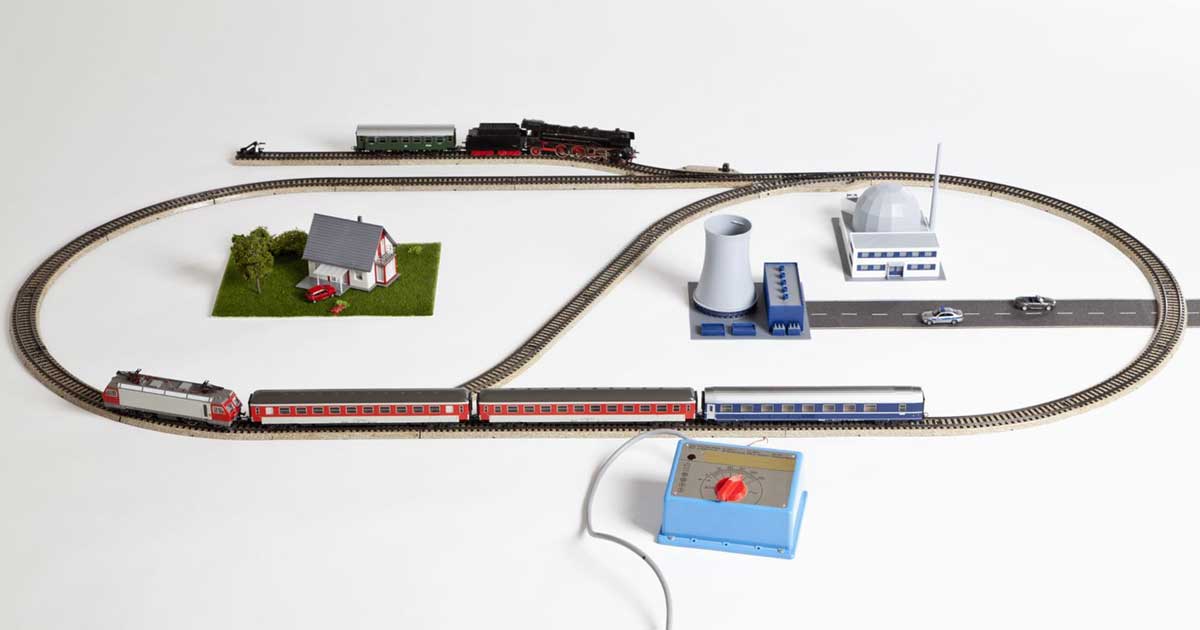
The Ultimate Guide to Model Train Power Supplies
Everything ya need to know for reliable, smooth-running layouts
At Hearns Hobbies, we've seen countless model rail enthusiasts struggle with power issues that could've been avoided with proper planning. This comprehensive guide sorts through the confusion and gives you practical advice on selecting power systems that'll keep your trains running smoothly for years to come.
From standard DC transformers to cutting-edge digital controllers, and critical protection components like surge protectors, we'll demystify the technical bits and help you make choices that suit your budget, scale, and ambitions. Let's dive into everything you should know to keep your miniature world humming along without a hitch.
| Model Train Power Supplies at a Glance | ||
|---|---|---|
| Topic | What You'll Learn | Related Products |
| Power Fundamentals | How volts, amps and watts affect your trains' performance | Wiring & Power Solutions |
| Control Systems | Comparing AC, DC and DCC systems for different layout needs | Digital Systems & Decoders |
| Safety & Protection | Essential components to prevent damage from shorts and surges | DCC Surge Protection |
| Wireless Options | Modern Bluetooth and wireless control technologies | Digital Control Accessories |
| Layout Distribution | Bus wiring, power blocks, and feeding techniques for reliable operation | Railway Lighting Systems |
| Compatibility Guide | Making sense of power requirements by scale and manufacturer | Featured Brands |
Why Your Power Supply Choice Matters
Many beginners make the mistake of thinking all power supplies are basically the same – just plug in whatever came with the set and off ya go! That approach might work initially, but as your collection grows and your layout expands, power limitations become obvious real quick. Trains crawl up inclines, locomotives stutter at track joints, and accessories operate unpredictably.
The right power supply isn't just about getting trains moving – it influences:
- Running quality – smooth acceleration, consistent speeds, and reliable operation
- Locomotive longevity – protecting delicate motors and electronic components
- Layout expandability – supporting future additions without complete rewiring
- Control precision – especially important for switching operations and coupling
- Accessory function – from simple lighting to animated scenes and sound effects
We've worked with thousands of modellers who've discovered that upgrading their power system was the single most effective improvement they made to their layout. Let's get ya sorted with the right setup from the beginning!
Important Safety Note:
While model train voltages aren't typically dangerous to humans, they can damage expensive locomotives and controllers. Always disconnect power before making wiring changes, and consider using a surge protector to safeguard your valuable equipment.
I'll continue developing the next sections in upcoming parts of this article, including detailed explanations of power fundamentals, different system types, and advanced setup considerations for your model railway.
Understanding the Basics: Volts, Amps & Watts
Before we jump into the different power supplies available, it's worth gettin' your head around the electrical basics that'll make or break your model railway experience. Three critical terms you'll encounter are volts, amps, and watts — and each one plays a crucial role in how well your trains perform.

Voltage (V): The Speed Controller
Think of voltage as the "pressure" pushing electricity through your layout. It directly affects how fast your trains can go:
- N Scale: typically runs best with 12V power supplies
- HO Scale: typically uses 12-16V DC for optimal performance
- O Scale: often requires 18V AC for traditional three-rail systems, while modern two-rail O scale may use 12-18V DC
- G Scale: typically runs on 18-22V DC, with up to 24V for larger power-hungry locomotives on outdoor layouts
Running a locomotive with too little voltage means sluggish performance and stalling on inclines or curves. Too much voltage risks overheating motors and premature wear on components.
For reliable operation, explore our range of scale-appropriate transformers that deliver consistent, clean power matched to your trains' requirements.
Amperage (A): The Power Capacity
If voltage determines speed, amperage (measured in amps) determines how much work your power supply can handle simultaneously. Think of amps as the amount of electrical "flow" available for your entire layout.
A higher amp rating means you can run:
- More locomotives at once
- More accessories and lighting
- Longer track runs without voltage drop
- Features like smoke generators and sound effects
Most beginner layouts can get by with 1-2 amps, but serious enthusiasts should consider power supplies rated for 3-5 amps or even higher for complex setups.
Watts (W): The Total Output
Watts represent the total power capability and are calculated by multiplying volts × amps. For example, a 16V power supply rated at 5 amps delivers 80 watts of total power.
When browsing our Wiring & Power collection, you'll notice that higher-wattage units generally:
- Cost more upfront but offer better value long-term
- Provide more headroom for layout expansion
- Run cooler under heavy loads
- Last longer due to less electrical stress
When in doubt, it's always better to have a bit more power capacity than you think you'll need. Many hobbyists regret buying an underpowered supply that limits their layout's potential.
DC vs AC vs DCC Power Systems: Which Is Right for You?
The model railway world has evolved with several different power systems, each with distinct advantages. Your choice depends on your goals, budget, and how complex you want your operation to be.
DC (Direct Current) Systems
DC remains the most common power system for most hobbyists, especially beginners. Here's why it might be right for you:
- Simple operation: Change direction by reversing polarity
- Affordable entry point: Basic DC controllers start from just $40
- Compatible with most models: Nearly all locomotives work with DC out of the box
- Easy to understand: Speed control through voltage adjustment
- Low maintenance: Fewer electronic components to fail
The limitation? You can only control one train per electrical block, which means more complicated wiring if you want to run multiple trains independently.
AC (Alternating Current) Systems
AC power is most commonly found in traditional three-rail systems like Lionel O gauge trains. Its features include:
- Robust power delivery: Great for older, high-current motors
- Simple reversing action: Using a direction button rather than polarity switching
- Compatibility with older vintage trains: Especially pre-1970s models
- Traditional accessory operation: Many classic accessories were designed for AC
Modern track systems predominantly use DC or DCC, but AC remains important for collectors and vintage enthusiasts.

DCC (Digital Command Control) Systems
DCC represents the cutting edge of model train control and offers unprecedented flexibility:
- Multiple train operation: Run several trains independently on the same track
- Individual locomotive addressing: Control each engine separately with a unique ID
- Built-in effects: Lighting, sound, and animation controls integrated into the system
- Computer integration: Easily interfaces with digital accessories and automation
- Wireless capability: Many systems offer smartphone or tablet control options
While DCC requires a larger initial investment—starting around $200 for a basic starter system—the operational benefits make it increasingly popular even among casual hobbyists.
Comparison Table: Power System Features
| Feature | DC System | AC System | DCC System |
|---|---|---|---|
| Initial Cost | Low ($40-100) | Medium ($80-150) | High ($200-500+) |
| Ease of Setup | Very Easy | Easy | Moderate |
| Control Options | Basic | Basic-Moderate | Advanced |
| Multi-Train Operation | Requires Block Wiring | Requires Block Wiring | Built-in |
| Future Expandability | Limited | Limited | Extensive |
Safety First: Protecting Your Investment
Model trains and their electronic components aren't cheap, and a single electrical fault can cause hundreds of dollars in damage. Smart hobbyists protect their layouts with preventative measures.
Essential Protection Components
Modern model railway enthusiasts should consider these essential safety components:
-
Circuit Breakers: These automatically cut power when they detect a short circuit, protecting your locomotives and controllers from damage.
-
Surge Protectors: Devices like the DCC Concepts Surge Protector safeguard against voltage spikes that can fry sensitive decoders.
-
Power Distribution Boards: These provide organized, protected power distribution to multiple tracks or accessories, reducing wiring complexity.
-
Isolating Switches: Allow you to cut power to specific sections for maintenance or testing without shutting down the entire layout.

Common Electrical Issues & Prevention
I've seen many hobbyists face these typical problems that proper protection could've prevented:
-
Rail Shorts: Caused by metal objects across rails or derailed locomotives. Solution: Automatic circuit breakers that trip and reset.
-
Reverse Polarity Damage: Happens when power connections are accidentally reversed. Solution: Polarity protection diodes in your main power feed.
-
Overheating Transformers: Often occurs when drawing too much current. Solution: Choose a power supply with ample headroom (30% more capacity than you think you need).
-
Accessory Power Spikes: Can happen when motors start or stop. Solution: Separate power circuits for accessories and locomotives.
Pro Tip:
Create a simple testing jig with a small piece of track and a low-amp bulb in series. If the bulb lights up when you place a locomotive on the track, there's a short circuit you need to investigate before connecting to your main power supply.
Power Distribution for Reliable Operation
Even the best power supply won't deliver consistent performance if your layout's wiring isn't up to scratch. Proper power distribution ensures that every centimetre of track receives adequate voltage.
The Bus and Feeder Method
For layouts larger than a simple oval, a bus and feeder system is absolutely essential:
-
Bus Wires: These are thick wires (14-12 AWG) that run underneath your layout, carrying power to all areas with minimal resistance.
-
Feeder Wires: Thinner wires (20-18 AWG) that connect from the bus to individual track sections every 60-90 cm.
This approach prevents the common problem of voltage drop, where trains slow down in distant parts of the layout because the rails themselves aren't efficient conductors over long distances.
Power Blocks and Isolated Sections
Dividing your layout into electrical blocks offers several advantages:
- Independent Control: Run multiple trains on different blocks (with DC systems)
- Easier Troubleshooting: Isolate electrical problems to specific areas
- Operational Possibilities: Create signaling systems and automatic stops
- Selective Power Application: Save energy by powering only active sections
Our track accessories collection includes insulated rail joiners and toggle switches perfect for creating these power blocks.
Special Considerations for DCC Layouts
DCC systems deliver both power and digital control signals through the rails, which means special attention to wiring is critical:
- Heavier Gauge Bus Wires: DCC typically needs thicker bus wires due to higher current demands
- More Frequent Feeders: Connect feeders every 60cm to ensure reliable signal transmission
- Booster Districts: Large layouts may need additional DCC boosters to maintain signal quality
- Proper Grounding: Essential for preventing interference with digital signals
For comprehensive DCC wiring components, explore our digital systems collection, which includes everything from command stations to boosters and auto-reversing modules.
Powering Layout Accessories & Lighting
Your trains aren't the only things needing power on your layout. Accessories, signals, buildings, and scenery lighting all require electricity too. A well-planned power strategy separates these circuits from your track power.
Separate Power Supplies for Accessories
There are several compelling reasons to use dedicated power supplies for accessories:
- Noise Isolation: Prevents motor noise from affecting lighting and digital components
- Appropriate Voltage: Many accessories work best at 12V rather than track voltage
- Surge Prevention: Protects sensitive electronics from locomotive power demands
- Independent Control: Turn accessories on/off without affecting train operation
Our Railway Lighting section offers purpose-built power supplies ideal for accessories and illumination.
Powering Building & Scenic Lighting
For realistic scene lighting:
- LED Strip Lighting: Perfect for street lights and building illumination
- Individual LEDs: Great for traffic signals and indicator lights
- Fiber Optics: Ideal for stars, fires, and special effects
- Animation Controllers: Add movement effects like flickering fires or neon signs
Most lighting can run on 12V DC, making it easy to power from inexpensive wall adapters designed specifically for model railway lighting.
Smart Layout Automation
Today's power systems can integrate with computers and smart controllers to automate operations:
- Sensor-triggered events: Trains activate crossing gates or station announcements
- Time-based lighting: Buildings illuminate as evening approaches on your layout
- Sequential operations: One train action triggers another after a set delay
- Remote control via smartphone: Control everything from a mobile device
These advanced features require careful power planning but offer incredibly realistic operation. Our digital accessories collection includes the components needed for these sophisticated setups.
Upgrading Your Power System: When and How
Many model railway enthusiasts begin with a basic power pack included with a starter set, but eventually outgrow its capabilities. How do you know when it's time to upgrade?
Signs You Need a Power Upgrade
Watch for these telltale indicators:
- Inconsistent Train Speed: Locomotives slow down in certain track sections
- Controller Overheating: Your power pack gets unusually warm during operation
- Limited Control Options: Basic controllers lack the features you now want
- Expansion Limitations: You can't add more trains or accessories
- Desire for Multi-Train Operation: You want to run several trains independently
If you're experiencing these issues, it's probably time to consider upgrading your power system.
Upgrade Paths for Different Budgets
Depending on your budget and goals, consider these upgrade options:
Budget-Friendly Upgrades
- Higher-amperage DC power pack
- Better-quality speed controllers
- Basic block control systems
- Improved wiring and distribution
Mid-Range Improvements
- Entry-level DCC starter system
- Wireless throttle controllers
- Computer interface for DC systems
- Advanced power management components
Premium Solutions
- Full-featured DCC command stations
- Smartphone/tablet control systems
- Automation and signaling integration
- Layout-wide power management systems
Transitioning from DC to DCC
Many modellers eventually make the switch from traditional DC to DCC control. Here's how to make this transition smoothly:
-
Start with a quality starter set from brands like DCC Concepts or NCE
-
Convert locomotives gradually, beginning with your most frequently used models
-
Upgrade your wiring to meet DCC requirements for reliability
-
Add features incrementally rather than trying to implement everything at once
-
Consider keeping a DC option for running non-DCC locomotives temporarily
Not sure which upgrade path is right for you? Visit our shop to speak with our experienced staff who can recommend the best solution for your specific layout and goals.
Power Requirements by Scale
Different model railway scales have varying power requirements. Understanding these differences helps you select the appropriate power supply for your particular models.
N Scale (1:160)
Being the smallest popular scale, N scale trains have modest power requirements:
- Recommended Voltage: 0-12V DC
- Typical Current Draw: 0.2-0.3A per locomotive
- Power Supply Rating: 1-2A is adequate for most layouts
- Special Considerations: Sensitive to voltage fluctuations; clean power is crucial
For N scale enthusiasts, we recommend our N scale specific controllers that provide the gentle control these precise models require.
HO Scale (1:87)
The most popular scale worldwide, HO has moderate power needs:
- Recommended Voltage: 0-16V DC
- Typical Current Draw: 0.3-0.5A per locomotive
- Power Supply Rating: 2-3A for average layouts
- Special Considerations: Good balance of power and control requirements
Explore our comprehensive range of HO scale trains and matching power systems for optimal performance.
O Scale (1:48) and G Scale (1:22.5)
Larger scales demand more robust power delivery:
- Recommended Voltage: 0-18V (O Scale) or 0-24V (G Scale)
- Typical Current Draw: 1A+ per locomotive
- Power Supply Rating: 5A+ recommended
- Special Considerations: Heavy-duty wiring essential; voltage drop more pronounced
Our selection of O and G scale trains includes appropriate high-capacity power options designed specifically for these power-hungry models.
Compatibility Chart: Power Suppliers and Scales
| Power Supply Type | N Scale | HO Scale | O Scale | G Scale |
|---|---|---|---|---|
| Basic Starter Pack (1A) | Suitable | Limited | Not Suitable | Not Suitable |
| Mid-Range Pack (3A) | Excellent | Suitable | Limited | Not Suitable |
| Advanced Pack (5A+) | Overkill | Excellent | Suitable | Limited |
| Heavy-Duty System (10A) | Excessive | Overkill | Excellent | Suitable |
Frequently Asked Questions
Can I mix DC and DCC on the same layout?
Ya can run both systems, but not simultaneously on the same track. Your options include:
- Installing a toggle switch to change between DC and DCC power sources
- Creating separate power districts with their own dedicated systems
- Using DCC-equipped locomotives with "dual-mode" decoders that can run on DC systems
- Setting up a programming track that runs on DC while your main layout uses DCC
Keep in mind that repeatedly switching between power types can potentially damage sensitive components in some locomotives.
Why do my trains slow down in certain sections of track?
If your trains consistently lose speed in specific areas, you're likely experiencing voltage drop. This happens when:
- Track feeders are too far apart (should be every 60-90cm)
- Bus wires are too thin for your layout size (use 12-14 AWG for main buses)
- Rail joiners have poor electrical connections or corrosion
- Track sections are dirty or oxidized, increasing resistance
- Your power supply lacks sufficient amperage for your layout demands
The fix is usually adding more feeder wires connecting your track directly to your power bus, rather than relying on rail joiners for electrical continuity. Check out our wiring solutions to solve these common issues.
Is it worth upgrading to DCC if I only run a few trains?
Even with just a couple of locomotives, DCC offers benefits that many hobbyists find worthwhile:
- Independent control of multiple trains without complex block wiring
- More realistic operation with controllable lighting and sound effects
- Smoother low-speed control and superior braking performance
- Future expandability without rewiring your entire layout
- Easier integration with computer control and automation
If you're happy with simple DC operation and don't plan to expand, you might not need DCC right away. But most enthusiasts who make the switch rarely go back, even for smaller layouts. Our entry-level DCC starter sets offer an affordable way to test the waters.
Conclusion: Powering Up Your Model Railway Journey
Choosing the right power supply might not be the most glamorous part of model railroading, but as we've seen, it's absolutely crucial to creating a reliable, enjoyable layout that'll provide years of trouble-free operation. The right power setup forms the foundation that makes everything else possible – from smooth-running locomotives to realistic lighting and animation effects.
At Hearns Hobbies, we've helped thousands of modellers transform their layouts from frustrating stop-start affairs into smoothly operating miniature worlds. Whether you're just starting out with a simple DC setup or ready to dive into the expanded possibilities of DCC, investing in quality power components will pay dividends through better performance and fewer headaches down the track.
Remember These Key Points:
- Always choose a power supply with more capacity than you think you'll need
- Distribute power efficiently with proper bus wiring and frequent feeders
- Protect your investment with circuit breakers and surge protection
- Consider future expansion when making power system choices
- Keep track and connections clean for optimal electrical performance