 is here! Shop now, pay later in 4 easy installments


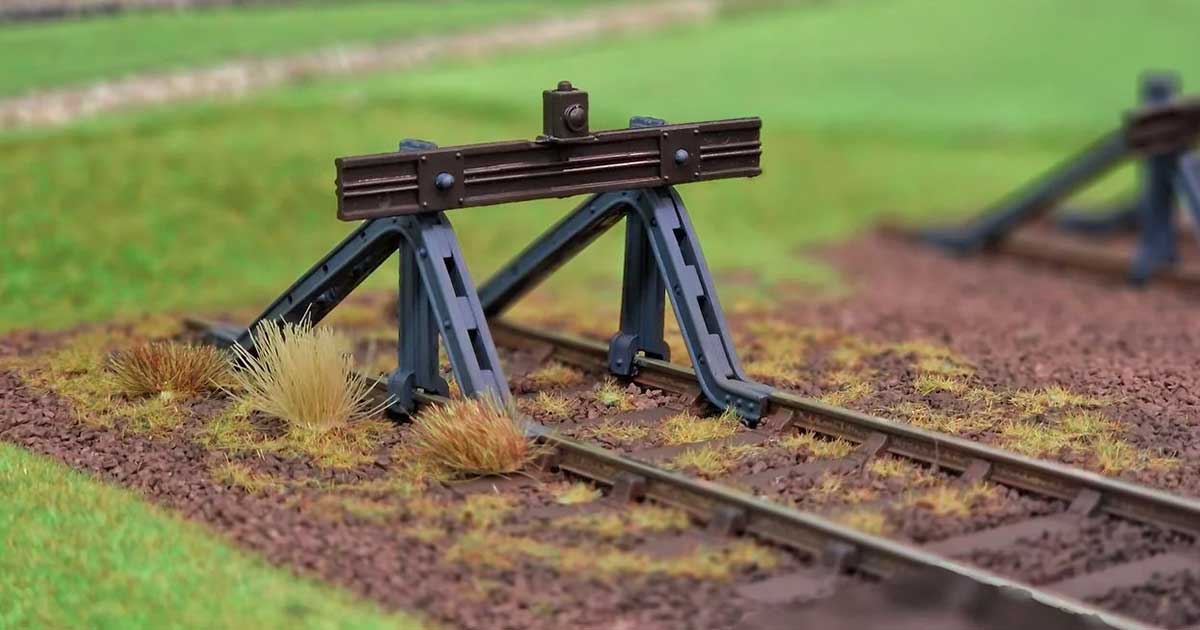
Spring vs Fixed Buffer Stops for Different Scale Railways
Ever watched a model train slam into the end of a siding and thought "that can't be good for the motor"? You're absolutely right. After selling thousands of buffer stops over the years and hearing countless tales of derailed locos and snapped couplers, we reckon it's time to properly explain the difference between spring-loaded and fixed buffer stops – and why choosing wrong could cost you more than just a broken buffer beam.
The thing most modellers don't realise is that buffer stops aren't just scenic items. They're functional safety devices that protect your valuable locomotives and rolling stock from disaster. Whether you're running N scale on a shelf layout or operating a massive OO gauge terminus station, the type of buffer stop you choose actually matters quite a bit.
We've seen everything from elaborate spring-loaded hydraulic buffers that actually compress on impact to simple Peco fixed stops that wouldn't budge if you hit them with a real train. Some modellers swear by the realism of working buffers, while others reckon fixed stops are all you need. So who's right? Well, like most things in model railways, it depends on your scale, operating style, and whether you value protection or authenticity more.
Let's dive into the technical bits without getting too boring. Modern model railways run at surprisingly high scale speeds – that Hornby Class 66 thundering into your goods yard might be doing the equivalent of 40mph when it hits the buffers. The kinetic energy involved can damage delicate valve gear, snap couplings, or even strip plastic gears in cheaper mechanisms. This is where the spring versus fixed debate gets interesting.
Table of Contents
Understanding Buffer Stop Basics
Before we get into the spring versus fixed debate, let's establish what a buffer stop actually does on your layout. In prototype railways, these hefty structures prevent trains from overrunning the end of tracks in terminals, sidings, and yards. They're basically the full stop at the end of a railway sentence – and just like punctuation, getting them wrong can completely change the meaning (or in this case, send your favourite locomotive flying off the layout).
Real buffer stops range from simple timber constructions on rural sidings to massive hydraulic rams at major terminals like London Paddington. The energy absorption principles are fascinating – converting kinetic energy into heat through friction, compression of springs or hydraulic fluid, or deformation of materials. But here's where model railways differ: our trains weigh grams not tonnes, yet they can still pack enough punch to cause expensive damage.
The physics get a bit weird at model scale. A HO scale locomotive weighing 300 grams hitting buffers at scale 60mph has different momentum characteristics than its full-size counterpart. The forces involved won't crush metal or shatter timber, but they're perfectly capable of stripping plastic gears, bending valve gear, or launching lightweight wagons into orbit. That's why choosing between spring and fixed buffers isn't just about looks.
Most modellers first encounter buffer stops as scenic elements – something to make the end of a platform look finished. But experienced operators know they're actually critical safety equipment, especially if you're running DCC or have automated sections. One programming error or sticky relay, and suddenly your prize Bachmann Deltic is testing Newton's laws against an immovable object.
![[SUGGESTED IMAGE: Comparison showing different types of model railway buffer stops - both spring-loaded and fixed versions in various scales]](https://www.hearnshobbies.com/cdn/shop/files/SL40_9454ec48-cd60-4692-991d-9e35497b5aad.jpg?v=1736428748&width=500)
Quick Physics Lesson
The force of impact depends on mass times acceleration (F=ma), but in model railways, we're dealing with tiny masses at relatively high velocities. A 200-gram OO locomotive hitting buffers at scale 40mph generates roughly the same impact force as dropping it from 30cm height. That's enough to damage delicate details, but spring buffers can reduce this force by extending the deceleration time – basic physics that saves plastic lives!
Spring-Loaded Buffer Stops Explained
Spring-loaded buffer stops are the overachievers of the model railway world. These clever devices actually compress when hit, absorbing impact energy through spring tension rather than sudden deceleration. Think of them as tiny shock absorbers for your trains. The springs might be hidden inside the buffer heads, built into the mounting system, or even use elastic materials to provide give. Some high-end models from manufacturers like DCC Concepts feature remarkably realistic compression action.
The engineering behind spring buffers varies wildly. Basic versions use simple coil springs behind the buffer beam, compressing maybe 5-10mm on impact. More sophisticated designs incorporate progressive springs that get stiffer as they compress, mimicking real hydraulic buffers. We've even seen custom jobs using rubber bands, foam padding, and one memorable attempt involving tiny hydraulic pistons from RC car shocks (it worked, surprisingly).
But here's what nobody tells you about spring buffers: they need proper installation to work effectively. Mount them too rigidly and the springs can't compress properly. Too loose and they'll just tip over. The track leading to them needs to be dead straight for at least two wagon lengths, otherwise side forces during impact can derail lightweight stock. And don't even think about using them with points set against the train – that's asking for trouble.
Spring buffers excel in certain scenarios. If you're running heavy HO or OO gauge locomotives, especially older models with metal chassis, the cushioning effect can prevent gear damage. They're brilliant for fiddle yards where trains regularly reverse into stops at speed. And for exhibition layouts where derailments equal public embarrassment, spring buffers provide that extra margin of safety when demonstrating shunting operations.
Spring Buffer Advantages vs Disadvantages
| Advantages | Disadvantages |
|---|---|
| Absorbs impact energy effectively | More expensive than fixed alternatives |
| Protects delicate locomotive mechanisms | Springs can weaken over time |
| Reduces derailment risk on impact | Requires precise installation |
| Realistic compression movement | May not suit all era modelling |
| Better for heavy rolling stock | Can look oversized in smaller scales |
Fixed Buffer Stops and Their Applications
Fixed buffer stops are the stalwarts of model railways – simple, reliable, and about as subtle as a brick wall. No moving parts, no springs to maintain, just solid construction that stops trains dead in their tracks. Manufacturers like Hornby, Peco, and Bachmann produce dozens of variations, from basic rail-built stops to elaborate terminal buffers complete with lamps and warning signs.
The beauty of fixed buffers lies in their simplicity. Screw them to your track, maybe add a dab of CA glue for insurance, and you're done. No adjustment, no maintenance, no wondering if the springs are still working. They're particularly brilliant for N gauge where the lighter rolling stock doesn't generate enough force to compress springs anyway, or for heritage layouts where prototypical accuracy trumps operational features.
But – and this is important – fixed buffers demand respect. Hit them too hard and something's got to give, usually your couplings or the buffer beams on your stock. We've seen steam locomotives lose their front steps, coaches shed their corridor connections, and one memorable incident where a ham-fisted shunting move launched a guard's van clean over the buffers onto the station concourse. Physics doesn't care about your careful weathering job.
Where fixed buffers really shine is in period modelling. Pre-war layouts, narrow gauge lines, and industrial sidings often had basic timber or rail-built stops that didn't compress. Using spring buffers here would be like putting DCC sound in a Victorian locomotive – technically impressive but historically wonky. The range of fixed buffers available is staggering too, from simple sleeper-built stops to ornate Victorian hydraulic rams (non-working, obviously).
![[SUGGESTED IMAGE: Various fixed buffer stops installed on a model railway layout, showing different styles from simple timber stops to ornate terminal buffers]](https://www.hearnshobbies.com/cdn/shop/products/66-sl940.jpg?v=1747947321&width=900)
Scale-Specific Considerations
Scale changes everything when it comes to buffer stops. What works brilliantly in OO gauge might be completely wrong for N scale, and don't even get us started on the unique challenges of OO9 narrow gauge. The physics, aesthetics, and practical considerations shift dramatically as you move between scales, making one-size-fits-all advice pretty useless.
Starting with N gauge (1:148/160), the tiny size and light weight of rolling stock means spring buffers often don't work properly. The springs need to be so delicate that they either compress from a butterfly landing or are too stiff to compress at all. Most N gauge modellers stick with fixed buffers, relying on careful operation and maybe a bit of foam padding hidden behind for insurance. Kato makes some lovely fixed stops that look the part without overcomplicating things.
Moving up to HO scale (1:87) and OO gauge (1:76), we hit the sweet spot for spring buffers. The rolling stock has enough mass to compress springs properly, but not so much that you need industrial-strength springs. This is where products from Hornby and Peco really shine, offering both spring and fixed options. The visual impact works too – you can actually see the buffer compression happening, adding operational interest.
The narrow gauge scales like OO9 and NG7 present unique challenges. These layouts often represent light railways with basic infrastructure, where elaborate spring buffers would look completely out of place. A slate quarry siding wouldn't have hydraulic buffers – it'd have a pile of old sleepers or maybe just a heap of ballast. Fixed buffers, especially scratch-built ones, suit the ramshackle narrow gauge aesthetic perfectly.
N Scale (1:148/160) Recommendations
- Fixed buffers work best
- Hidden foam padding for protection
- Focus on visual accuracy
- Lighter stock needs less protection
- Spring buffers often too stiff
HO/OO Scale Recommendations
- Spring buffers highly effective
- Good range of both types available
- Consider operation style
- DCC layouts benefit from springs
- Heavy locos need protection
TT Scale Note: At 1:120, TT scale sits between N and HO. Spring buffers can work but need careful selection. The limited commercial options mean many TT modellers make their own hybrid solutions using fixed buffers with hidden cushioning.
Installation and Track Planning Tips
Right, let's talk installation because this is where good intentions meet reality, and reality usually wins. We've seen beautifully detailed buffer stops installed so badly they're worse than useless – trains either derailing before impact or the buffers themselves becoming catapult devices. Proper installation starts with planning, not just slapping buffers at the end of your track and hoping for the best.
First rule: the approach track must be arrow-straight for at least three wagon lengths before the buffers. Any curve, no matter how gentle, introduces side forces during impact that'll derail lightweight stock faster than you can say "buffer stop." If you absolutely must have buffers on a curve (and honestly, try not to), use fixed types and accept you'll need to approach dead slow. Track alignment tools are your friend here.
Height matters more than most modellers realise. Buffer stops need to align precisely with the buffer height of your rolling stock – too high and wagons slip underneath, too low and they ride up over the top. This gets complicated with mixed traffic; a diesel locomotive's buffers might be at different heights than your Victorian coaches. The solution? Set buffer height for your most valuable stock and operate everything else carefully.
For spring buffers, mounting rigidity is critical. They need a solid foundation that won't flex but allows the spring mechanism to work. Many modellers mount them on a separate piece of plywood screwed to the baseboard, giving a firm base while allowing future adjustment. Don't glue spring buffers permanently – you might need to service those springs eventually, and trust us, trying to maintain glued-in-place buffers is miserable.
Pro Installation Tip
Before fixing buffers permanently, temporarily mount them with double-sided tape and test with your longest wheelbase locomotive and your lightest wagon. Run both at various speeds (carefully!) to check for derailments, ride-up, or inadequate stopping. Adjust height and position until everything works smoothly. This ten-minute test saves hours of frustration later.
Operational Impact and Safety Features
The operational differences between spring and fixed buffers become really obvious during running sessions. Spring buffers change how you operate – you can shunt with a bit more enthusiasm, knowing there's forgiveness built in. We've watched operators at exhibitions visibly relax when they realise the fiddle yard has spring buffers. That confidence translates into smoother, more realistic operations without the tentative creeping that fixed buffers demand.
But here's something interesting: spring buffers can actually mask poor operating practices. That cushioning effect might save your locomotive's valve gear, but it's also teaching bad habits. Prototype trains didn't ram buffer stops at 20mph just because they could compress a bit. If you're serious about realistic operation, fixed buffers enforce the discipline of proper speed control and accurate stopping.
For DCC layouts with automated sequences, spring buffers provide crucial insurance. Programming errors, encoder miscounts, or detection failures can send trains careering into buffers without warning. Spring buffers might not prevent the collision, but they'll reduce damage. Several automation systems now include "buffer stop approach" speed restrictions in their software, but mechanical protection beats electronic promises every time.
Safety extends beyond just protecting rolling stock. Fixed buffers with sharp edges or protruding details can scratch hands during manual uncoupling or derailment recovery. Spring buffers with exposed mechanisms can pinch fingers or catch loose clothing. Consider your layout's accessibility when choosing – if you're regularly reaching across buffers to uncouple wagons, smooth, rounded designs prevent bloodshed and torn shirts.
![[SUGGESTED IMAGE: Close-up of a model train approaching buffer stops, showing proper coupling alignment and safe stopping distance]](https://www.hearnshobbies.com/cdn/shop/products/66-sl41.jpg?v=1746909565&width=1000)
Choosing the Right Buffer Stop for Your Layout
So how do you actually choose between spring and fixed buffers? Start with your operating style. If you're running intensive shunting operations, particularly with diesel shunters reversing into sidings repeatedly, spring buffers will save your sanity and your stock. Exhibition layouts benefit from springs too – nothing kills credibility like a derailment during a demonstration, and spring buffers provide that safety margin when you're distracted by questions from the public.
Layout location matters more than you'd think. Terminus stations with multiple platforms might need different buffer types on each road. Passenger platforms could have ornate fixed buffers for visual impact, while the parcels bay gets functional spring buffers for rough shunting. Hidden sidings and fiddle yards almost always benefit from spring buffers – nobody sees them, so appearance doesn't matter, but protection absolutely does.
Consider your rolling stock value too. If you're running limited edition locomotives or irreplaceable kit-built models, spring buffers are cheap insurance. But if your fleet consists of robust Hornby Railroad models that can take a beating, fixed buffers might be perfectly adequate. We know collectors with separate "runners" and "shelf queens" who use spring buffers exclusively when the valuable stuff comes out.
Don't forget era and prototype accuracy. A model of Paddington circa 1950 needs those massive hydraulic buffers (even if they're actually fixed), while a Welsh slate quarry needs nothing fancier than a pile of sleepers. Research your prototype – heritage railway photographs are gold for buffer stop details. Sometimes the "wrong" choice operationally is the right choice visually, and that's a perfectly valid decision.
Quick Decision Matrix
| If You Have... | Choose... | Because... |
|---|---|---|
| N scale layout | Fixed buffers | Light stock doesn't compress springs effectively |
| Automated DCC | Spring buffers | Protection against programming errors |
| Period steam layout | Fixed (usually) | Historical accuracy trumps function |
| Exhibition layout | Spring buffers | Reduces public embarrassment |
| Modern image | Either works | Modern stops vary widely |
Maintenance and Long-Term Considerations
Nobody talks about buffer stop maintenance, probably because it's about as exciting as watching paint dry. But ignore it at your peril – we've seen spring buffers seize solid after years of dust accumulation, and fixed buffers work loose just when you need them most. A tiny bit of preventive maintenance saves massive headaches later.
Spring buffers need occasional attention to keep working smoothly. Every few months, work the mechanism by hand, checking for smooth compression and return. A tiny drop of light oil on the spring mechanism prevents corrosion, but don't overdo it – excess oil attracts dust like a magnet. If springs feel weak or don't return fully, they might need replacement. Keep spares handy because finding exact replacements years later is often impossible.
Fixed buffers seem maintenance-free, but they're not. Check mounting screws regularly – the repeated impacts can work them loose over time. Thread locker helps but makes future removal difficult. The buffer faces themselves accumulate grime from coupling hooks and hands, requiring occasional cleaning with isopropyl alcohol. Painted buffers might need touch-ups after particularly enthusiastic shunting sessions.
Long-term, consider obsolescence. That perfect spring buffer from a small manufacturer might become irreplaceable when they close shop. We always recommend buying spares of critical components while they're available. Fixed buffers are generally easier to replace or repair – worst case, you can usually bodge something that looks similar. Spring mechanisms are harder to replicate once the original fails.
Maintenance Schedule
Monthly: Visual inspection for alignment and damage
Quarterly: Test spring compression, check mounting security
Annually: Deep clean, lubricate springs, repaint if needed
As needed: Replace worn springs, tighten loose mountings, touch up paint
Frequently Asked Questions
Can I convert fixed buffer stops to spring-loaded ones?
Yes, but it's usually more trouble than it's worth. The conversion requires precise engineering to add springs without compromising the buffer's appearance or stability. Some modellers hide small springs or foam rubber behind fixed buffers for protection, which gives you impact absorption without visible modification. For OO and HO scales, commercial spring buffer units from DCC Concepts or similar manufacturers are purpose-built and more reliable than DIY conversions. If you're handy with small mechanisms, RC car shock absorbers can be adapted, but honestly, buying proper spring buffers is usually cheaper than the time and materials for conversion.
What's the ideal stopping distance before buffer stops?
In the real world, trains should stop with buffers untouched – they're emergency devices, not parking aids. For models, aim to stop locomotives about 10-20mm (in HO/OO) before buffers during normal operations. This gives you margin for error without relying on buffer contact. With DCC, you can program deceleration curves to achieve consistent stopping points. For N scale, 5-10mm is plenty. Installing a small stopping marker on the sleepers helps drivers (that's you!) judge distance, especially in poor lighting. Some operators paint a tiny white line on the rail as a reference point.
Do light-up buffer stops affect the spring vs fixed decision?
Light-up buffers with working lamps add brilliant atmosphere but complicate the spring/fixed choice. Most illuminated buffers are fixed because adding LED wiring to moving parts is asking for trouble. The constant flexing from spring compression can break delicate wires or connections. If you want both springs and lights, mount them separately – spring buffers for protection with fixed illuminated buffers slightly behind as scenic elements. DCC Concepts makes some clever designs with built-in lighting that sidestep this problem, but they're pricey. For most layouts, choosing between protection (springs) and atmosphere (lights) depends on your priorities.
How do buffer stops work with different coupling types?
This is trickier than most people realise. Tension-lock couplings common in British OO can ride up over low buffers, while Kadee-style couplers might slip under high ones. European models with close-coupling mechanisms need buffers at exactly the right height or they'll clash with the coupling heads. The solution varies by scale: adjustable-height buffer stops exist for HO scale, while N scalers often modify buffer heights with thin washers. Test with your specific coupling types before permanent installation – what works for NEM couplings might fail completely with scale three-link chains.
Final Thoughts
After all this technical discussion, here's the bottom line: both spring and fixed buffer stops have their place on modern model railways. The "right" choice depends entirely on your specific circumstances – scale, operating style, era modelled, and how much you value your rolling stock. There's no universal answer, despite what forum experts might insist.
For most modellers, a mix of both types makes sense. Use spring buffers in hidden areas, fiddle yards, and anywhere expensive locomotives regularly reverse. Install fixed buffers where appearance matters most – passenger terminals, scenic sidings, and heritage settings. This hybrid approach gives you protection where needed and authenticity where it counts. Remember, model railways are meant to be enjoyed, not stressed over, so choose whatever helps you relax and run trains confidently.
The technology keeps evolving too. New materials, 3D printing, and clever engineering mean tomorrow's buffer stops might make today's spring versus fixed debate obsolete. We're already seeing smart buffers with built-in sensors for automation, and hydraulic-damped mechanisms that work at model scale. Until those become mainstream though, understanding the current options helps you make informed decisions for your layout.